Solar Smash: The Most Satisfying Planet-Destruction Sandbox
-
There's something oddly the rapeutic about watching a planet come apart at the seams. No story to follow, no score to chase — just you, a spinning world, and a panel full of absurd weapons. That's the entire premise of Solar Smash, a planet-destruction sandbox originally developed by Paradyme Games for mobile. With over 50 million downloads on phones and tablets, the game has earned a massive following. Now, a browser version makes it accessible on desktop and mobile alike — no download, no account, no friction. You open it, pick a weapon, and start breaking things.
Free to play at: Solar Smash
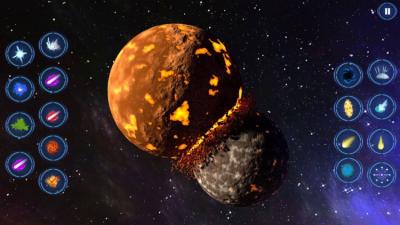
What keeps people coming back isn't just the novelty of blowing up Earth. It's the physics. Solar Smash doesn't fake destruction with canned animations. Debris fragments follow gravitational pull. Magma pools realistically at crater edges. A black hole doesn't just delete a planet — it pulls every chunk into a slow, spiraling death. Each weapon produces a genuinely different outcome, and experimenting with combinations is where the real fun lives.
Gameplay: How It Actually Works
The controls are refreshingly simple. A weapon panel sits on the left side of the screen. Tap or click an icon to select it, then tap or click the planet to fire. Some weapons — like the laser beam and ion cannon — support click-and-drag, letting you slice across the surface or sustain a beam on a single point. You rotate the planet by dragging the background, and pinch-to-zoom works on touchscreens.
The weapon roster is more varied than you'd expect. Nuclear missiles leave deep, glowing craters. The railgun salvo delivers rapid sequential strikes across a hemisphere. Asteroids scale with size — small ones hit like nukes, while the largest rip entire continents off on contact. The alien invasion option sends a fleet of tiny ships that methodically disassemble the surface, which is slower than brute-force weapons but oddly mesmerizing to watch.
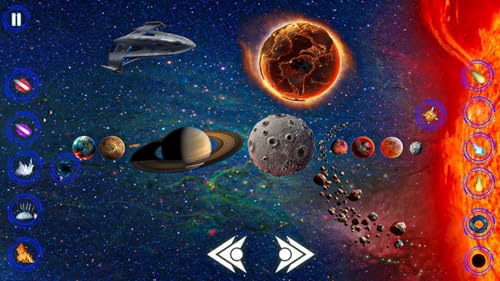
Beyond Earth, you can cycle through multiple celestial targets — the Moon, Mars, gas giant variants, and other bodies. Each has a different crust thickness and core behavior, so a weapon combo that cleanly splits Earth might barely scratch a denser moon-sized rock. The planet selector sits at the top of the screen, and swapping targets keeps the experimentation loop fresh.
Tips: Getting More Out of Each Session
The most satisfying results come from layering your attacks rather than spamming one weapon. Here's a simple approach that works well: start with a railgun salvo to strip away surface rock and expose the mantle. Then deploy a black hole nearby to pull loose debris clear. Finally, fire a sustained laser straight through the exposed core. The result is a hollow, fractured planet that no single weapon could produce on its own.
A few other things worth trying:
Drag the laser from pole to pole for a clean bisection attempt. Equator-to-pole cuts tend to be the most dramatic.
Stack multiple nuclear missiles in one hemisphere before detonating for maximum surface damage in a concentrated area.
Try the ice comet on a planet that's already cracked open. The thermal contrast between frozen surface and exposed magma underneath is genuinely impressive.
Don't rush the black hole. Let it work. Watching debris spiral inward fragment by fragment is one of the most visually satisfying things in the game.
There's no wrong way to play. No missions, no timers, no fail states. If you want to methodically peel a planet layer by layer, do that. If you want to fire everything at once and watch the chaos, that works too.
Conclusion
Solar Smash isn't trying to be deep. It's a sandbox with one job — let you destroy planets in creative, physics-driven ways — and it does that job remarkably well. The browser version removes every barrier to entry: no app store, no storage space, no login screen. Just open it and play.
It's the kind of game you pull up during a break, spend fifteen minutes experimenting with weapon combos, and close feeling strangely relaxed. If you enjoy sandbox physics games like Sandboxels, People Playground, or Melon Playground, Solar Smash fits right into that same category — casual, creative, and endlessly replayable. Give it a try the next time you need to decompress. The planet can take it.